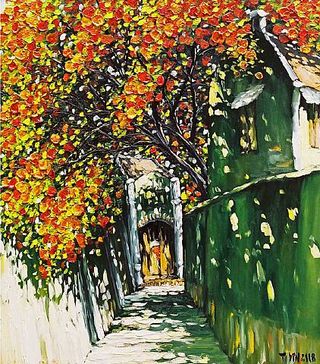
The year of a giant earthquake ends with warmth up from my socks Ban'ya Natsuishi
Like the clear sound of tinkling jade (玉声), Natsuishi's haiku reverberated as music in my heart. For this was, indeed, the year of the giant earthquake. And, for me, it was very much a year of thinking--perhaps not unlike Voltaire did in Candide--about what it is to live through dark times and how we as human beings can make sense of things like mega earthquakes.
But what is it to think about things like this?
Heidegger once said he wanted to differentiate between thinking as pure ratiocination and what he described as the pre-Socratic notion of thinking (noein) as "perceiving," or of being attentive to something. This would be to suggest that through our imaginative attention to the world around us--through this kind of "thinking"-- we take to mind and heart. And then, --in the words of Robert Harrison, we are saved by the vision:
What appears to the eyes then becomes spiritualized and, as spirit, enters the onlooker's inner being, inspiring the soul to emit a sigh. From this sigh of inspiration--this culminating intake and exhalation of breath--the poem we are reading is born.
In my own life, I am not sure I have ever lived through a year when things have felt so utterly unstable--from the shaking of the earth and the tsunami, to the news overseas and at home. Yesterday, I stumbled across a blog post about a recent study of income inequality in the roman empire in which even imperial Rome fared better than today's America. And from here on the ground, it sure does feel that way. I wonder who couldn't feel the same that 2011 has been a tumulutuous year. For me, at least, the mood has been of great instability within and without-- as if 10,000 things are out of balance and the center cannot hold...
But like Natsuishi's haiku above, my year-of-the-great-earthquake also ended with a very quiet appreciation of warmth--of the warmth of family and friends; of music heard in poetry, and always of the natural beauty that surrounds me. Like the warmth of the poet's socks, these small, near and dear things---- sing.
The year of a giant earthquake ends-- with the geese returning to the lake -- Peony
If anyone wanted to send in a poem for the end of the year of the great earthquake, that would be wonderful.
**
Painting is a very unsual ZHANG DAQIAN 張大千 (1899-1983) that will appear here again soon, called GAZING AT A RED SPIDER (1939年作)
It quite possibly is the greatest art historical discovery of our lifetime. A lost Leonardo da Vinci painting of Jesus Christ. And not just any painting of Jesus Christ but a salvator mundi, orsavior of the world.
The last Leonardo painting that was found was discovered one hundred years ago at the Hermitage, making the Salvator Mundi the 16th Leonardo painting that we know of. I would love to see it-- the luminiscence of the chest and forhead--and those eyes, it is so reminiscent of the Mona Lisa, isn't it? And the beautiful textiles remind me of La Belle Ferronniere; his robe in my favorite color, Huizong's shimmering shade of blue.
Scholars had known about the painting from various mentions of it here and there, as well as copies by other artists and preparatory drawings done by the Master himself. The providence of this work sounds sketchy, but we know it was first mentioned when it entered the royal collection of Charles II in 1649 and then sold a hundred years later when it was put up at auction by his son. It then totally disappeared from the record until 1900, when it entered the collection of Sir Frederick Cook (but by then it had been disfigured by damage but also by the overpaint restorations--that it was a Leonardo had by this time been utterly forgotten). It was in 1958 that the painting made its Atlantic crossing--entering an American collection. For 50 years, we --again---know nothing. But then in 2005, it came up for sale at an estate sale--and it was then that those handling the auction of the painting became intrigued--first by the curls of his hair (like his John the Baptist)--"so very Leonardesque"-- and then, by that orb.
++
It is extraordinary really. To my eyes (in the images online I have seen so far), the painting has a sublime quality that is reminscent of the Kudara Kannon Statue (百済観音) at Horyuji. Carved (probably by Korean artists) out of a piece of camphor wood, it is gilded in bronze. Like Leonardo's Christ, Kannon holds one hand in blessing, and in the other she holds a vessel containing the "nectar" of compassion. Also like the Leonardo, the Kannon looks straight at you--and yet looks beyond you. The Salvator Mundi--like Kannon-- blesses human kind as he makes his promise to save us.
In addition to the orb (more below), scholars became convinced that no other master could paint hands in that manner. So expressive, graceful --and more, an x-ray inspection revealed that the painter had a "change of heart" and had altered the position of the thumb-- thereby suggesting that this was no copy.
The orb too is extraordinary. While usually orbs are depicted in brass or maybe glass-- for these are terrestrial globes-- Leonardo's was rock crystal. Like a crystal ball, rock crystal symbolized for Leonardo clarity of vision; healing and grace ("saving"); and clairvoyance. Leonardo's Christ was making his promise to heal and to save "the world." Art historians say that at that time period, no one but an artist of Leonardo's skill would have been capable of depicting refraction within the orb as Christ held it-- the world-- in his hand. (Salvator Mundi: It's all Balls).
++
I am reading a book right now about another "American Leonardo." Did you know that there are more important Italian Renaissance paintings in the United States than anywhere else on earth--except for their country of origin? Of course, most are on the other coast. But even in Southern California, there are a suprising number of Rembrandts. No Leonardos however that I know of.
The American Leonardo is about a famous court battle, Hahn versus Duveen, that ocurred in 1929 over a supposed Leonardo. It had to be the most sensational art trial ever--well at least until the getty and their recent troubles!
In a nutshell, a Kansas man, who was stationed in France during World War II, returned home with a French bride, who herself was in possession of a painting that she declared to be an original Leonardo. An identical picture attributed to Leonardo Da Vinci is in the Louvre: La Belle Ferroniere.
So, which was the fake?
At the time, American art connoisseurship was dominated by a millionaire art dealer, named Joseph Duveen. And, Duveen pronounced the Hahn's painting was the fake--calling the painting all kinds of names to boot. So, the Hahns sued. For obviously, in one fell swoop Duveen had killed their chances of ever selling their painting--and they wondered, was it fair for him to pass judgement like that without even having inspected it in person? But, he had insisted that he didn't need to see it at all--for the photo alone showed him all he needed to know.
Fair enough?
There is so much that is interesting about this book.
It was America's Gilded Age and the millionaire robber barons wanted to buy art. J.P. Morgan, Cornelius Vanderbilt, Henry Clay Frick, Andrew Mellon, John D. Rockefeller--all these men were Duveen's clients. America was dripping in wealth--but it was still a young country and had no real high culture of its "own." And so the mega-rich of the Gilded Age sought Italian Renaissance art-- in this way buying art was also buying class for the New Barons. At the same time, however, there was also a very strong civic dimension to it. That the art was to be donated to the nation was a given. This was the project. It was thought of as something to both cultivate the American wealthy class (to try and stop the tide of rampant consumerism and conspicuous consumption) but also a means for them to help do their part to build the country's cultural standing through massive art donations to America's museums.
These men for the most part did not have a solid background in art and so they all depended utterly on the advice of experts, like Duveen. But the experts received their commissions based on the painting in question's sale--so there was a major conflict in interest since they would benefit substantially by claiming works of art to be worth more than they perhaps really were. Restoration too followed as restorers, with the attribution, would then make their changes accordingly.
See how the last restoration utterly altered the face and the lighting of Salivor Mundi, for example: Salvator Mundi Disclosed and this absolutely amazing video about the restoration--about the glaze and the air bubbles in the orb.
In short, the "expert" became more important in art collecting practices than in any time in history. And for the experts in Gilded Age America, connoisseurship was about--above all-- attribution. The robber barons wanted "names"-- to be connected (individually but also as a nation) to those great giants of Renaissance art. Providence mattered too, but as the experts declared, it was the object itself that was their primary interest. And what gave them their specialist know-how was an immense body of embodied knowledge. That is, the experts went out and examined as many paintings as possible so that, in addition to detailed examinations of technique (say, how a particular painter handled "curls") they worked by an overall sense or intuition which was based on years of actually looking at paintings. The legendary connoisseurs of the time sometimes called it "picture hunting"--for they would devote years sometimes to scouring Italy to "see" and to drink in as many paintings as they could.
Duveen did discuss the scientific evidence-- for example the Hahn painting showed a paucity of expensive pigments (Leonardo just used richer and more costly pigments) but to Duveen, he said he just "knew" it was not a Leonardo and that this was something he felt in his gut based on years of looking at Renaissance art. This was a skillful sensibility achieved by lifetime of aesthetic cultivation that was based on embodied experience (rather than book knowledge or science). Duveen stated it again and again at trial-- aeshetics are everything and that he knew what he was talking about it!
(The jury was not impressed and Duveen ended up having to settle with the Hahns out of court for $60,000 in damages).
Having a good eye is what they call it. And, this detached, de-contextualized objective seeing is straight out of Kant. While there are certainly other traditions with different priorities (for example, see my post Anatomy of an Art Collector for the Japanese and Southeast Asian traditions), it seems almost universal that all people feel that art is uplifting. And that works of art have charisma and power ---and therefore owning them can become a kind of alchemy as well; transforming a person by putting one in touch with powerful exemplary models-- or in the case of Leonardo da Vinci-- with a genius almighty.
The story of the Persian Prince Pirooz was nominated by a friend of this blog for the 3Quarks Daily Prize for Politics and Social Science. About a shining prince-- the son of the last Sassanid King-- who traveled to the Tang court sometime around 670 after his own glorious empire had been crushed by Arab conquerers was inspiration for Kyoto Journal's Special Silk Roads Issue of last year. Though it was the inspiration, it wasn't included in the issue so I was glad to see it nominated for the 3Quarks Prize!
He was not just the greatest artist in the Catholic world, but he was an art collector and a classically trained humanist who was knighted by both Philip IV of Spain and Charles I of England. Indeed, so sure was he of his place in the world that he painted himself with sword in hand before the knighting even took place!
I am reading Simon Schama's wonderful book on Rembrandt. And who should come out as shining prince in the book--not Rembrandt-- but Rubens. In the time-old method of understanding one thing but pairing it against its opposite, Schama in order to uncover Rembrandt, illuminates Rubens.
They were night and day, Rubens and Rembrandt. While the older painter was the soul of taste, a stoic and a devout Catholic, Rembrandt was a Calvinist vulgarian. “Rubens’s most ardent admirers … [celebrated] the Flemish painter’s commitment to discrimination,” writes Schama.“Rembrandt, on the other hand … had no idea when to avert his gaze.” Fittingly, Rubens died a painter-aristocrat who dabbled in diplomacy and was universally mourned. Rembrandt went bankrupt and expired penniless in a hovel just seven years after he had disinterred his wife’s bones so that he could sell the grave to stave off his creditors.
I mean, just look at the self-portrait of Rubens and his new wife sitting among the honeysuckles. Is it not the ultimate expression of marriage (fidelity and union)? So different from Japanese poses, but the hands really are very evocative of this very touching ancient European (Roman) gesture of *promising.* I love her bracelets too. And of course her hat, which seems somehow totally at odds with the rest of her outfit, doesn’t it? I do think they are charming and seem so in love... it’s a favorite of mine. If only I had met my knight when I was sixteen and he eighteen years older—just back from Italy and so handsome in mustard tights! And if only I was fonder of millstone collars. It is the dream of happily-ever-after...
And, you have to admit not all that many painters or poets dared to express happily ever after, did they? Marriage being seen more as a fortress besieged 围城 than as source of poetry and art.
Not for the faint of heart, more common has always been the theme of romantic love and longing of the non-conjugal sort where the promise was only ever at most an ambiguous promise to come visiting that night.
♥
Yesterday, my favorite poet (and someone very dear to my heart) Samuel Peralta made an adaptation of a poem by Fujiwara no Teika. Rubens had said that, "My talent is such that no undertaking, however vast in size has ever surpassed my courage.” And, I think Sam is himself Rubenseque in his talent and confidence to re-think and re-work a poem from one the greatest poets of all time. The great Teika.
こぬ人を On the Matsuo Shore まつほの浦の I wait for him 夕なぎに Pining for him in the quiet of the evening 焼くやもしほの My longing burns me 身もこがれつつ Like the seaweed burned to gather salt (牡丹訳)
Truly, Teika was one of the great giants of poetry. And, in the same way that sam re-illuminates Teika, Teika himself was alluding to another very famous ancient poem from the Manyoshu (935) by Kasa no Kanmura:
淡路島 At Awaji 松帆の浦に Along the Matsuo shore 朝なぎに In the quiet of the morning 玉藻刈りつつ They reap jeweled seaweed 夕なぎに In the quiet of the evening 藻塩焼きつつ They burn the seaweed to gather salt 海人娘女 Fishermaidens at the shore ありとは聞けど -- I've heard of them at least 見に行かむ Though I am unable よしのなければ To go and see for myself --- 笠 金村 (巻6-935)
As a translator, I wanted (in my translation above) to retain the echoes from the earlier poem--of the evening calm and the shore but I also wanted to retain as much as I could the idea of longing (matsu in Japanese means pine tree but it also means to wait and to long for--so for a thousand years was the symbol par excellance of a pining women). As Sam says, this poem is so filled with sadness, absence and longing. But, more, what I think Sam's rendition (below) captured better than any is the second play on words, of moshio.
Moshio: Gathering salt from seaweed. In old times, after being soaked in saltwater, seaweed was dried in the sun. It was then burned to dry it before it was boiled to produce salt. In poetry, "yaku" (to burn) and "moshio" (gathering salt from seaweed) are associated with the theme of "longing" and are used in poetry as a set (ie moshio→ longing) 詞.
Dusk falls in Matsuo, late. As the charred salt, wrung From simmered seaweed, burns – So smolder the ashes of this heart, As I wait for you, as I wait
That nothing new is ever born is a fact. I think Rushdie is someone who has explored this in particularly interesting ways and in many of his books, there will be one character or another who claims that “Nothing comes from nothing, Thieflet; no story comes from nowhere; new stories are born from old-it is the new combinations that make them new.” Haroun and the Sea of Stories.
And so in the same way that the Great Teika writes in allusion to the ancient Manyoshu poet Kasa no Kanmura, so too does Samuel Peralta light up Teika's poem to give it new life, in Modern Antiquity.
Over a thousand mountains, birds disappear from sight
Over ten thousand paths, peoples' footprints all extinguised
Floating in a small boat, sits an old man in a straw raincoat and conical hat
All alone fishing in the frozen river, snow falling
**
For many years now, Palinurus has been much on my mind. Palinurus at the helm--in fear and dread--dread of the water; dread of the waves, dread of the thick mists, and dread of that god damn boat that was all that kept Aeneus and his men from the cold waters below.
Is it not one of the great Western literary images par excellance? A boat drifting in stormy seas... Like Romeo bitterly complaining that he is "no pilot"--and so, alas, remains unable to steer his boat away from the tragedy of being utterly dashed up against the rocks.
Palinurus' boat is no Polynesian outrigger gliding gracefully, effortlessly on the water's surface-- headed south toward Tahiti-- no, theirs is a tiny boat full of gaping holes being tossed about atop cold, deathly waters.
Sometimes at night when I close my eyes, I almost feel the rise and fall of the swell.
And we all know what it is like to feel as vulnerable as Palinurus.
Others would gratefully succomb to the temptation of sleep. Release, as he called it. But not Palinurus-- for his promise was too great. And so he grasps the tiller--griped in fear and bathed in the mists of sleep.
You see, this is why I hate boats.
Sailing toward Athens across stormy Adriatic waters-- all I could think of was the limbless bronzes, sunk down at the bottom looking up at us. Laughing at our temerity. Yes, I pity Palinurus-- I pity his promise, I pity his occupation, I pity his fate. And, I loath the feckless waves.
Today, though, Ting-Jen had posted the poem and photograph by Dong Hong-Oai above on facebook.I wanted to try a translation of my own and in doing so I felt the image of the drifting boat on stormy waters to be turned on its head... drifting... for isn't Liu Zongyuan continuing in the tradition of Tao Yuanming's 採菊東籬下-- Plucking chrysanthemums by the eastern fence? The old man alone fishing in the snow is no depressing poetic cry lamenting his fate like in Romeo and Juliet. Quite the opposite for the image illuminates what is the serenity achieved by a lifetime of cultivation at the end of the hero's journey.
Drifting.
Fishing.
All alone in a boat, in the snow--with nothing but a straw raincoat and a conical hat.
I'm not afraid of storms; for I'm learning to sail my ship. -Aeschylus;
At the Borobudur, there is one stone relief depicting the buddhist story of the seafarers. I don't know too much about it--just that sometimes a boat (goard/egg/boat of salvation) is likened to that which carries a person to enlightenment. Googling "boats and buddhism" and "boats and daoism," I discover what is a really very different view of this literary image and metaphor. I would love to learn more--for now my favorite that I came up with is this below:
Life is like stepping onto a boat that is about to sail out to sea and sink. Shunryu Suzuki
Wispy mist and thick clouds The afternoon stretches on, endlessly in sadness Sweet incense rises from a golden brazier On this auspicious festival day—Chongyang. As evening fall, the chills slips in Through silken curtains to my little jade pillow
Sipping wine that evening—there by the eastern fence The fragrance of the chrysanthemums filling up my sleeves, secretely, quietly How can I not be distraught? The autumn wind fills the curtains I have grown thinner than the chrysanthemums.
Li Qingzhao--longing for her husband who was faraway on business, spent the day in bed-- drinking wine and composing poems, in the shadow of the flowers by the eastern fence(採菊東籬下).
Sending him the poem, it is said that when he read it, so impressed was he that he vowed to not leave his room until he had composed a poem back of equal perfection. Refusing all food and all visitors for three days, he composed poem after poem. Later, he would incorporate her words with words of his own in a poem that a friend would remark about, "there are only three good lines in this one" (and those three good lines were, of course, the ones he had borrowed from his wife's masterpiece!)
She was the greatest poetess in Chinese history. And like all great poets, she sought to refine her emotions in elegant and edifying metaphors about nature. Lady Li loved flowers and by situating her emotions in seasonal images, personal emotions were therby refined and made universal. But at the same time, she saw things in the flowers themselves that were admirable and worthy of emulation; for not only are flowers beautiful and joyous but they also symbolize strength and nobility of character-- attributes that we can all learn from. Or, in the words of my ikebana teacher, when a flower blooms, it either blooms in its fullest capacity and with all its might, or it’s a dud.
No half measures for flowers. --with Ting-Jen
Interesting article on emotion, nature and japanese Buddhism--here. Photo and video by the Great Ninagawa Mika
Be like a flower, from Sri Aurobindo's The Spiritual Significance of Flowers
Be like a flower. One must try to become like a flower: open, frank, equal, generous and kind. Do you know what it means? A flower is open to all that surrounds it: Nature, light, the rays of the sun, the wind, etc. It exerts a spontaneous influence on all that is around it. It radiates a joy and a beauty. It is frank: it hides nothing of its beauty, and lets it flow frankly out of itself. What is within, what is in its depths, it lets it come out so that everyone can see it. It is equal: it has no preference. Everyone can enjoy its beauty and its perfume, without rivalry. It is equal and the same for everybody. There is no difference, or anything whatsoever. Then generous: without reserve or restriction, how it gives the mysterious beauty and the very own perfume of Nature. It sacrifices itself entirely for our pleasure, even its life it sacrifices to express this beauty and the secret of the things gathered within itself. And then, kind: it has such a tenderness, it is so sweet, so close to us, so loving. Its presence fills us with joy. It is always cheerful and happy. Happy is he who can exchange his qualities with the real qualities of the flowers. Try to cultivate in yourself their refined qualities
The year was 1683 and the Grand Vizier of the Ottoman Empire, Kara Mustafa Pasha, led one of the most organized war machines on earth. He was leading them westward-- toward Vienna. We know now that his campaign would end in defeat. The Pasha himself held ultimately responsible, he would be made to suffer the punishment of death by strangulation; his head then delivered to the Sultan back in Constantinople in a velvet bag.
Make sure you tie the knott right, he is supposed to have said to his executioners as they prepared to tie the silken cord around his neck.
But imagine how optimistic he must have been just months earlier as he led the powerful Ottoman toward the city walls of Vienna.
Pure formality, the Ottoman army had first sent an official demand for surrender of the city. Both sides, however, were well aware that they would have to fight to the finish: take the city versus defend the city. Treaties, entreaties and traitors opening the gates from the inside not being likely options.
And so after receiving rejection to their official demand, the Ottoman army set to work digging tunnels under the city walls. Using little pick axes, they dug sitting down, creating tunnels in which they would use explosives to try and collapse the walls. The siege was vicious and food had been cut off, but the fortifications built by the Viennese a week before the arrival of the Ottoman army significantly slowed their adversaries down. Then, with the arrival of the Christian Polish relief army, the battle turned against the Pasha.
And, speaking of the famed Polish soldiers, perhaps the Battle of Vienna is most famous for their final calvary charge. The famed winged hussars-- led by the great King of Poland himself. After their triumph, he was said to have paraphrased Julius Caesar's famous quote:
"Venimus, Vidimus, Deus vincit" - "We came, We saw, God won."
**
I am listening to a really interesting In Our Time program about the Battle of Vienna. Even more than the famous naval battle at Lepanto, we know that the Battle of Vienna was at the time seen as a great clash of civilizations. Like the Battle of Talas or the Battle of Thermopylae, the Battle of Vienna was the stuff that would later be said to have profoundly changed the course of history. Indeed, even at the time, it was seen as a Clash of Civilizations: with Christians praying for a Christian victory in churches as far away as Britain and Catalonia.
The In Our Time homepage has this blurb on the battle:
The ensuing siege has been held responsible for many things, from the invention of the croissant to the creation of Viennese coffee. But most importantly, it has come to be seen as a clash of civilisations, one that helped to define a series of boundaries, between Europe and Asia, Christian and Muslim, Hapsburg and Ottoman, that influence the view between Vienna and Istanbul to this day. But to see the siege as a defining moment in east/west relations may be to read back into history an idea that was not true at the time.
This talk of boundaries is very interesting, I think, because it was more like a "series of boundaries" or "fault lines. Famous battles are almost always later said to have created boundaries between civilizations (as opposted to those less significantly interpreted battles fought between neighbors) And, this is certainly how the Battle of Talas, the Battle of Vienna and the Battle of Thermoplae are traditionally understood. The guests on the In Our Time show spoke about something they called "deep history," maybe a better term is simply "historical memory"? But, they discuss the way the battle continues to be significant in our historical memory even today; so that for example the issue of Turkey's inclusion in the EU would have a different emotive impact in Vienna then say in Britain.
**
Like many of the Readers of these Pages, I love history. And, I have mentioned before that I went through a period-- about 4 years in fact-- where I read almost exclusively song dynasty history. Reading in both Japanese and English, the books were all written in the style of intellectual history and hence were created in great part to "illuminate" the past (that is, they illuminated both the Song times but also the Tang times and the present times; see article on Al Andalus linked below, for example on revisionism in intellectual history).
I suppose, too, that this type of resionary or illuminary history-writing is in many ways the polar opposite of Kapuscinski's portrayal of Herodotus' project of "real time seeing" or "looking." As he says,
But not just to look but to try and write down what he saw in order not to forget it. Not necessarily that any truth can be illuminated but only this aim of leaving behind a trace of what happened. It is, I think, a human impulse-- this desire to remember. This was, after all, why Herodotus tells us that he wrote down his own travels-- in unending run-on sentences that overflowed onto countless papyrus scrolls.
I think it takes a certain kind of person to practice this type of history. (Does anyone really practice oral history anymore? Even the journalists nowadays seem to be in the narrative-making business) I find myself thinking a lot about the art of doing looking and tale-telling (l'histoire) -- about this idea of standing in the world and writing history as it actually is taking place; at that precise moment where present tense becomes past tense. Somehow I think it is bound up in the notion of the ethics of care. And, I wonder if doing oral history is not one of the most significant and humane approaches to history. Especially when it is practiced in order to tell the stories of those otherwise who would not have a voice: history as telling tales: l'histoire (as story and history)
Another really good In Our Time program called "A History of History" started off its show with these words:
In the 6th century AD, the bishop of Tours began his history of the world with a simple observation that “A great many things keep happening, some of them good, some of them bad”
That about sums it up I guess...
All the art work comes from Biblioddysey's fabulous post Feuerwerksbuch. The artillary is at least a hundred years "behind-the-times" but I was unable to find anything more contemporary to the Battle (sorry!)
****
RECOMMENDED: This from William Dalrymple on the dangers of cultural provincialism and US politics: Home Truths on Abroad
Kannazuki 神無月-- There is an old belief in Japan that during the Tenth Month, all the gods from the various provinces come together in Izumo to discuss affairs of state. And with all the gods of the land away from home on business, the Tenth Month has come to be known as "Kannazuki" ("the month of no gods").
Despite the absence of gods, the Tenth Month still manages to awe, arriving as it does wrapped in a glorious cloud of fragrance. At least in Tochigi-- for almost as soon as October rolls around, the sweet perfume of the fragrant olive blossoms overwhelm.
Sweet Osmanthus, in English, it is also known as the fragrant olive. In Japanese, it called kinmokusei 金木犀 --that is, "golden," "tree," "rhinoceros." Why rhinoceros? Well, apparently the ancients felt that the tree's gray mottled bark resembled the hide of a rhinoceros. An evergreen shrub or tree, kinmokusei is native to China and the Himalaya, and for many people the fragrance is more a symbol of October than even the chrysathemums. My friend Chieko often complained about the gloomy "northern country" skies of Paris. Autumn in Paris must be beautiful, I always thought. No, she said, it's too far north. There is no beautiful autumn foliage: no clear, blue autumn skies; no celebrated mid-autumn moon and no kinmokusei!"
They also love kinmokusei in Hong Kong and the flowers are used in jams and sweets, and dried osmanthus flowers are infused with oolong and green teas to produce what Hong Kongers call, 桂花茶-- katsura blossom tea. I sent some to Chieko in Paris for her morning tea and she cried saying, "Oh the fragrance makes me long for our home in Mejirodai."
In China, where the tree is native, there are many varieties. Most are also known by the same chinese characters 金木犀 , or 木犀 (mùxī). The flowers of the tree, however, are referred to as guì huā (桂花, in English, "cinnamon flower" or "cassia flower"). And, it is the blossoming of this flower that was posited as one of the possible causes for why the moon is so particularly beautiful in Autumn. For the ancient Chinese believed that the "katsura" trees on the moon blossomed during the fall and it was their luminous color which caused the "harvest moon" to glow orange.
This idea, then, filtered into Heian Japan and so we find one of my all time favoritewakafrom the kokinshu:
久方の月の桂も秋はなほもみじすればやてりまさるらむ ただみね Might it be because The cinnabar tree on the moon changes colors in autumn that the autumn moon shines so brightly-- Tadamine
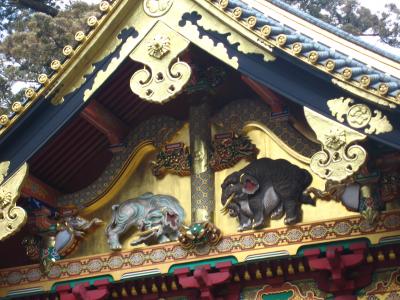
Interestingly, though, it wasn't until way into the Edo period that the trees even arrived in Japan, so the above poem was based purely on imaginative transmission-- like the wood carvings of elephants created at Nikko created by sculptors who had never seen such an animal.
And speaking of those blossoming lunar trees, in China, a beautiful young man 桂男-, who lives on the moon-- was thought to be responsible for having planted the trees up there. The monster-loving Japanese, however, believed that the man on the moon was an incredibly elegant and handsome demon, and women were cautioned to never look too intently at the moon, otherwise the katsura-moon man would steal their souls! So beware!
A few days ago, I mentioned having found a poem to cross a desert with. I boldly said, I didn't even need the entire poem at all--just that one famous line: 採菊東籬下-- Plucking chrysanthemums by the eastern fence.
A popular subject for calligraphy or to be used for the seals of gentlemen on retirement, the phrase evokes the good life--not of La Dolce Vita but rather of the simple life; of a serenity achieved by a life of service and self-cultivation, where less is more and nature provides wonderful company.
It is, I think the simple truth that contentedness comes from being easily contented. And hence lies the great allure of plucking peonies (oops, I mean chrysanthemums).
A friend, having read my blog post then mysteriously posted another poem to my facebook wall:
"Passage of Sighs" Cao Zhi, AD 229
Carried out by strong winds Only wanting to return home Heading southward, the wind blows me northward Thinking it will blow eastward, it takes me westward Drifting, drifting, where will I end up? Surely I will perish and yet life continues Wandering through hills and plains Drifting and turning, no place to stay Who knows my hurt? I wish to be grass in the forest Burned in autumn fires Destroyed by fire-- does his extinguish the pain? Wishing for this with my roots remaining
Not surprising given he is a mysterious man, there was no explanation of why he posted it and at first I was thrown. So, I contacted the Great Professor Wang who kindly sent me the original Chinese and the historical context. In many ways, the story echoes the chaos experienced by Lady Li—a woman who lost everything she loved and yet chose the pen name, “easily contented” 易安 (whereby freedom is based less in our choices as in the ability to shape our lives around contingency).
Professor Wang explains,
This is supposed to be one of his later poems, sort of summarizing, and sighing over, his own painful life history, being blown here and there by successive political winds. His father, Cao Cao, chose Cao Zhi's brother Cao Pi to be his successor to the throne, and kept Cao Zhi far from the center of power; after he became emperor, Cao Pi had Cao Zhi and their other brothers sent away from the capital (blown this way and that by winds of change....)"
The winds of change and the winds of destiny, I suppose Cao Zhi felt as if he had fallen through the cracks of his own life. I am still not happy with the english in the last line (and would love help with it!) but I like very much this image of enduring and self-cultivation through the overcoming of hardships; love the image of the poet hoping only that his roots will survive the fire.
Is this not the perfect poem for a mid-life crisis par excellance?
What appears to the eyes then becomes spiritualized and, as spirit, enters the onlooker's inner being, inspiring the soul to emit a sigh. From this sigh of inspiration--this culminating intake and exhalation of breath--the poem we are reading is born.
As I have mentioned here many times before, Francois Jullien talking about daoist physiology brings up "breath phenomenon 氣象" and says that through one's in-haling and ex-haling, one breathes in landscape, atmosphere and social context and breathes out character, heart, correct behavior..............and poetry. Or as Rushdie says, "We inhale the world and breath out meaninf. While we can. While we can."
This kind of elegant sighing in the wind/sighing in the mountains happens again and again in Chinese literary history. A person's dreams are dashed by fate and they lose everything (like running out of a burning house). But, finding great solace in nature, they realize (and are grateful that) they are still able to sigh.
Suspiro ergo sum.
For Tao Yuangming it was plucking chysanthemums and for Su Shi, it was bamboo.
On Qian Seng's Green Bamboo Skin Veranda, by Sū Shì
I would rather eat a meal without meat
than live in a place without bamboo.
Eating without meat makes you lose weight,
but living without bamboo makes you lose refinement.
When a person loses weight, it may be regained,
but when scholars lose refinement they are untreatable.
Others will find these words funny,
seeming lofty and at the same time, crazy.
Ruminate on this carefully if you're wise,
or you'll never ride a crane to Paradise.
"於潛僧綠筠軒"
蘇軾
可使食無肉,不可居無竹。
無肉令人瘦,無竹令人俗。
人瘦尚可肥,士俗不可醫。
旁人笑此言,似高還似痴。
若對此君欠大嚼,世間哪有揚州鶴。
The translation is Professor Wang's, and he explains that the "cranes of Yangzhou in the last line is a metaphor for ascending to heaven." It reminds me of the paintings made in the Heian period which depicted Amida traveling down to earth over spectacular landscapes on whispy sighing clouds to come and meet the dying and escort them back to paradise. The paintings, called Amida raigo-zu 阿弥陀来迎図, were sometimes held up right in front of the aristocracy when they were on their deathbed--their last sights being these beautiful paintings of landscapes with Amida traveling down to meet them on the breath of clouds.
My traveling companion, many of You may recall, had been itching to get out of Dodge.
He had grown increasingly more anxious as our prospects for getting to Leh in time for the famous Hemis Festival began to look slimmer and slimmer. Air India was booked solid till the end of the month and the Srinigar-Leh Highway had still not announced its open date for the season. And so he had grown more and more discouraged. "We just have to get there somehow," he said, planning to walk over the passes if he had to. (See my post Kashmir)
As so often happens in life, the answer miraculously presented itself. We met a man who was planning to bribe his way on to the road before it officially opened. He had a contract with a German tour group, and said he was going "no matter what."
And so we headed off-- riding in a jeep at the head of a convoy of a dozen taxis full of German tourists.
The Srinagar-Leh Highway, built in the early 1960s, is probably typical of high altitude roads in that part of the world. A surprisingly smooth asphalt-paved "interstate," the road clings perilously to the side of the mountains. Rising up over dazzlingly high mountain passes, then descending into apricot-tree filled valleys along the Indus, it connects two very different worlds. (In the Himalaya, cultures are dispersed not be geogaphy but rather by altitude--so that similar culture zones don't necessarily exist side-by-side but rather at the same altitude on a mountain or valley somewhere else. This is something you really notice as these high-altitude roads rise and fall over and over again).
The most impressive transition ocurred at the very first pass-- the famous Zoji La. Rising up around 3500 feet, the pass is also known as the Gateway to Ladakh. It is the most beautiful mountain pass--you can see from the picture above that as you rise up, the green and very alpine valley of Kashmir spreads below like a beautiful dreamscape. Passing through the very narrow "gateway," however, you leave this alpine world behind, and --moving through the pass itself, which feels very much like Kawabata's tunnel in Snow Country-- you emerge into what is described as the moonscape of Ladakh. Utterly treeless and very, very rocky and desolate, I think it is too high up to get any rain. Surrounded in every direction with towering mountains, the landscape is very stark. Completely Surreal. A Moonscape.
The highest pass along the road is Fotu-la (4108 meters). Further on, however, on the road connecting Leh to Manali, there is an even higher pass which once had a sign reading:
Beacon Highway: Highest Road in the World. You Can Have a Dialogue with God
You get the picture. From Fotu-la, the road makes a series of hair-pin turns to descend into Lamayuru-- one of the most remote and important Tibetan monesteries in Ladakh.
What I want to write about, though, happened well before Lamayuru. In fact, it happened a full day before we even went over the Pass at Fotu-la-- not far from the first pass at Zoji-La.
It was there, just outside of Srinigar that a million goats seemed to appear out of nowehere.
People don't walk in LA. I don't drive and always feel lonely being the only one out walking along the roads. In contrast, in the Himalaya--in what seemed at first to be such an incredibly remote and really desolate landscape-- I was constantly surprised to see people here and there walking. "Where in the world were they headed?" I thought, and yet, there they were. And like that, seemingly out of nowhere, our convoy of Kashimiri taxis was surrounded by a million goats.
And so we stopped. And watched as an ocean of goats filled every inch of empy space on the road around us. It was like the tide coming in. And, in the midst of this ocean of goats-- a man. And, I could not take my eyes off him. I think I actually gasped because he was so unexpected. Unexpected and yet familar. It was love at first sight (or Shazaam as the Shiek says).
Pure magnetism and when our eyes locked on each other through the car window, it was all I could do to stop myself from jumping out. I mean, thinking back now, I am sure it was only my intense dislike of goats that stopped me. I have an incredibly impetuous nature... but it is also entirely possibly that I am allergic to goats.
Nearly two decades have gone by, but believe me when I tell you, that he is as vivid to me now as if I had seen him yesterday.
But then again, maybe not. In fact, somehow over the years, I think he has blended in my heart with the figure of the incredibly dashing Mahbub Ali, from Rudyard Kipling's Kim. You remember in the book where we get that first glimpse of Mahbub Ali in the Kashmir Serai in Lahore, that "huge open space square over against the railway station, surrounded with arched cloisters, where the camel and horse caravans put up on their return from Central Asia."
Just like Mahbub Ali, my man on the road to Leh was a tall Pashtun with a "scarlet-dyed beard." And to say that he had an air of mystery about him would only be an understatement.
And, at last Dear Readers, I get to my point.
I have been reading back and forth between two books this week. Gavin Young's In Search of Conrad and Peter Hopkirk's Quest for Kim. Both are absolutely fantastic, and I would only recommend one over the other depending on whether one was a Kipling fan or a Conrad fan. The project of both authors is precisely identical: to go and undercover the places and characters of the books that so profoundly affected the authors' lives. And, indeed, both authors are very, very clear about the way these books shaped their lives. For Hopkirk, it was an early reading of Kim that would set him on his life's journey to study, read and write about the Great Game. He says:
To a highly impressionable, romantically minded schoolboy of thirteen-- the same age as Kim himself--the mysterious, if murky activities of Mahbub Ali and Lurgan Sahib were heady stuff indeed... so spellbound was I by this glmpse into the workings of the Indian secret service that I carried a copy of Kim everywhere...
I felt the same about the novel and agree with Hopkirk that it perhaps does emit "an intense luminiscence." For this reason, too, I am friendly to Hopkirk's suggestion that a reading of Kim could cure a "nasty bout of depression." Indeed.
Young is no less devoted to Conrad as Hopkirk is to Kipling. For Gavin Young it was a schoolboy reading of Joseph Conrad's story Youth which was to so dramatically affect his life. He writes on page 1:
My obsession with Joseph Conrad got into its stride after my headmaster read a passage from the story Youth-- a story that said in so many words, "Catch life on the wing--but hurry!"-A message I took at full length.
And so I email a book-loving Pasha across the ocean. I complain to him about the way it feels that books no longer seem to have that same magical power to affect the way we live; the way we fall in love; the way we make choices and see things. I mean, would that breathtaking man on the road to Leh have had quite the same impact on me if I hadn't already been in love with the Kipling's story? Real life is filtered through imagination like a Gabriel Garcia Marquez novel. Magical realism and Abracadabra. "The novel is dying," for they say nowadays people don't have the patience for stories; preferring more useful information-gathering instead. But if imagination and storytelling are de-prioritized, or viewed as a tool "ready at hand" to be used as a form of amusement or entertainment, would this not impoverish the possibilities of imagination to create real meaning in our lives? hmmm..
+
Aliza Salario had a wonderful post on Elif Batuman's "how to make our lives more like the books we cherish" and why literature matters here. And the the glorious mural express (臥遊) here.
Recent Comments